
Mount Pleasant City Directory Holdings
Mount Pleasant history is usually found in Charleston and Greater Charleston directory publications, not in one Town-only run. The geographic reach changes with the edition. CCPL says early material may require a check for East of the Cooper or Mount Pleasant coverage, while later volumes increasingly include outlying areas. The CCPL directory collection brings together book abstracts, microfiche, microfilm, original books, telephone books, and a library-card route to digitized volumes. That mix makes it possible to work from a rough decade instead of assuming a single continuous series exists.
| Collection | Years | Where Held | Access |
|---|---|---|---|
| Book or microfiche abstracts | Selected issues, 1735 to 1859 | CCPL city-directory collection and South Carolina Room | Consult the listed format and verify East of the Cooper coverage |
| HeritageQuest directory run | 1830, 1859, 1866 to 1934, with stated gaps | CCPL HeritageQuest | Library-card access |
| Microfilm directories | 1866 to 1932, with stated gaps | CCPL and South Carolina Room | In-person research |
| Original directory books | 1934 to present selections; no 1995 or 2002 | CCPL | Check the locality section in each volume |
| Telephone books | 1931 to present, with stated gaps | South Carolina Room | Later corroboration only |
The CCPL directory collection page is the best starting point for a volume's stated format and gaps.
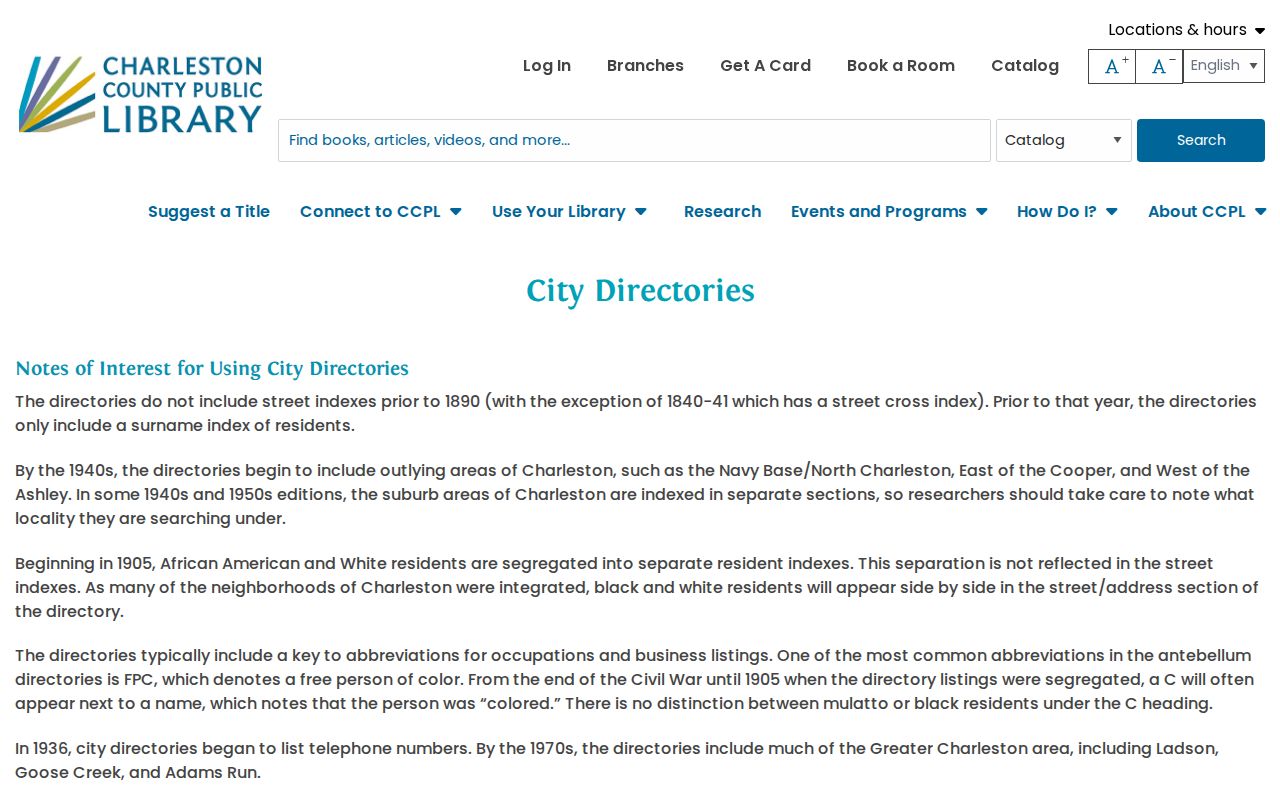
Its catalog notes make a missing year visible before a household trail is built around an edition that was never published or is not held.
Note: A directory listing is dated evidence from one edition, not a complete roster of everyone living in Mount Pleasant.
Mount Pleasant Directory Geography
The Town name is not a safe shortcut for every directory search. CCPL explains that outlying areas, including East of the Cooper, began appearing in the 1940s, and some directories in the 1940s and 1950s placed suburban areas in separate sections. A researcher who stops after the Charleston alphabetical pages can miss a relevant heading. By the 1970s, the series covered much of Greater Charleston, including places beyond Mount Pleasant, so the locality label matters as much as the surname.
Early city directories are Charleston-area sources. They can supply a household or business lead, but they should not be treated as proof that every early issue included all of modern Mount Pleasant. The useful approach is to inspect the title page, local heading, and index structure for the edition in hand. That restraint matters most when comparing a name found in one decade with an apparent absence in another. The absence may reflect the geography or layout of the volume rather than a move.
Mount Pleasant Directory Room Access
For deep historical work, CCPL directs researchers to the South Carolina Room and Charleston Archive. The collection holds books, maps, microfilm, clipping files, and research databases focused on Charleston, the Lowcountry, and South Carolina history. The research notice reviewed for this collection listed temporary, appointment-only access at 1248 Camp Road in Charleston, with a request to call 843-805-6956 or email before visiting. Confirm the current arrangement before making a trip. The Mount Pleasant branch is useful locally, but it is not a promise that the full historical shelf is available at Mathis Ferry Road.
The access routes differ by format. A CCPL card can open the digital HeritageQuest material, while microfilm, original books, staff help, and the deeper source collection call for library or room access. The HeritageQuest access page also includes census records from 1790 through 1930, which gives a household check between directory years. Appointment and staff inquiry are part of the research method, not an afterthought when an online search fails.
The CCPL historic-property research guide connects the directory shelf with maps, deeds, and older County records.
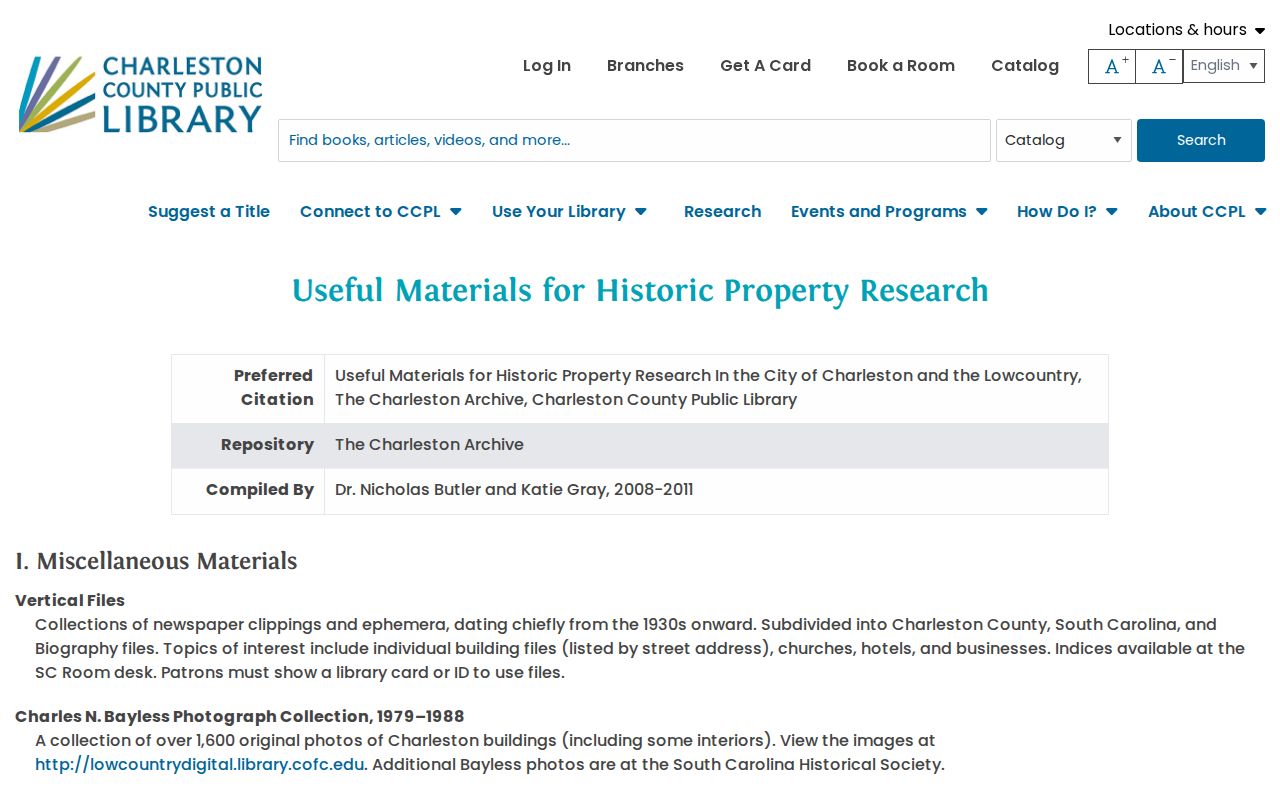
That connection is useful when a directory address needs a historic map or a deed-chain check, rather than a guess about who occupied a property.
Note: Confirm room access and any appointment requirements directly with CCPL before traveling with fragile materials.
Reading Mount Pleasant Directory Entries
A directory entry is a dated clue, not a fixed biography. CCPL describes these books as a pre-telephone reference that commonly lists residents alphabetically, an occupation abbreviation, a possible business address, and a home address. The historic-property guide says later listings may add details such as spouse, residence, employer, or race. No single Mount Pleasant entry image was reviewed, so the fields below describe what an edition may show. They are not a promised format for every volume.
| Possible entry field | What it may show |
|---|---|
| Surname and given name | The person printed in the alphabetical listing, sometimes with initials or a spelling variant. |
| Spouse or widow notation | A relationship clue where the edition prints one. |
| Residence | A home address or other residence notation for that directory year. |
| Occupation key | An abbreviation such as CLK for clerk or LAB for laborer, if the volume includes it. |
| Business or telephone detail | A work address or business clue, and a phone number in later editions where printed. |
| Street cross-reference | An address-based path only when that edition includes the applicable index. |
- Criss-cross directory
- A street-order listing that can connect an address to a printed occupant or business in editions with reverse listings.
- Householder index
- An alphabetical arrangement that usually leads with the primary listed adult, rather than a complete household list.
- Abbreviation key
- The volume's guide to shortened occupation and business terms; read it before assigning a meaning to a code.
A name, address, and work clue should be copied with the year and page. That record of the edition helps separate a real change from a later transcription mistake.
Mount Pleasant Directory Cross Indexes
Address searching has a precise limit in this collection. The historic-property guide identifies a street cross index for the 1840 directory and reverse street coverage from 1890 onward. Ordinary directories before 1890 generally do not have street indexes. For an 1870 address, begin with the surname listing rather than claiming a house-by-house lookup. For a qualifying later volume, use the street reference to find the listed address, then return to the alphabetical entry for the fuller clues that may be printed.
This is a useful local quirk. It prevents a modern address search from being pushed backward into years where the source was not built for it. The historic-property guide also places maps from the 1670s through the 1990s in the CCPL map cabinet, giving an additional way to test an old street or property description. An address match is still a printed lead, not proof of every occupant or a legal property conclusion.
Note: Reverse listings identify what a particular edition printed at an address, not every resident who may have been there.
Mount Pleasant Directory Index Context
Some historical directory layouts need extra care. CCPL reports that beginning in 1905 African American and White residents were separated into different resident indexes, while the street indexes did not follow that separation. An address or street check may therefore be more complete for an integrated neighborhood than relying on one name index. This is a description of the historical source's organization, not a modern classification or a reason to repeat the source's labels without context.
The collection also describes period abbreviations. Its occupation and business listings use a key. In antebellum volumes, FPC denotes a free person of color. From the end of the Civil War until 1905, a C beside a name commonly reflected the publication's historical racial notation. Quote a notation only when it is relevant to understanding the original record, preserve the year and page, and explain its period context. A historic directory can be valuable family-history evidence while still carrying the limits and social structure of the era that produced it.
Trace a Mount Pleasant Directory Household
Start with the strongest fact available: a name, an address, a rough decade, and likely spelling variants. A current Mount Pleasant address may need a Charleston County TMS, subdivision name, or old legal description before it can be compared with older material. From there, the household trail should move in small, dated steps. A changed listing can suggest a move, a marital-status change, a business change, or a source omission. It does not prove a death or a complete household departure.
- Choose the directory year nearest the known event and search surname-only, initials, spouse or widow forms, and common spelling variants.
- Before 1890, use the surname listing except for the 1840 to 1841 cross index. From 1890 onward, check the reverse street listing when the edition provides one.
- For 1940s and 1950s issues, inspect both the East of the Cooper or suburb section and any general listing.
- Carry each printed address, occupation, and spouse clue into the next available directory. Record the gap instead of filling it by inference.
- Pair the interval with the CCPL census resource. Census returns from 1850 list each household member, while directories commonly identify a primary adult.
Property and estate evidence can test the trail. A reverse listing can be compared with a parcel or deed chain, historic map, probate source, or obituary where an authoritative historical source supports the connection. For a current address question, the Mount Pleasant street address directory follows the modern County property path rather than repeating the historical shelf. A directory disappearance remains a lead to test, never a conclusion by itself.
Mount Pleasant Directory Gaps Matter
Later R. L. and E. L. Polk directory runs do not erase the need to inspect the catalog. CCPL identifies absences in 1949, 1952 to 1954, 1956 to 1957, and 1962 to 1967, while its pages vary over whether some adjacent years are listed separately. Original books also have stated gaps, including 1995 and 2002. The sound method is to use adjacent published editions and census material, then mark the missing year as a gap. A household cannot be assumed present simply because it appears before and after an unavailable issue.
Telephone books offer a later check, but they have their own limits. The South Carolina Room's run begins in 1931 and has listed gaps in 1932 to 1933, 1938 to 1939, 1942 to 1945, and 1959. CCPL says telephone numbers begin in the directories in 1936. A phone listing can support a time and address clue, subject to who was included, but it does not replace the dated directory entry.
Note: A catalog gap should remain documented, even when nearby editions suggest a likely household pattern.
Mount Pleasant Directory Milestones
The CCPL collection is not one uniform database. Its format, street access, and geographic coverage shift across the historical run. A date on the title page can determine whether a name search, a street check, or a separate locality section is the better starting point.
- 1735: CCPL lists an early abstract among its selected book and microfiche holdings.
- 1840 to 1841: The directory includes the unusual early street cross index.
- 1890 onward: Cross-reference street listings become available in qualifying later directories.
- 1905: Resident indexes began separating African American and White residents, while street indexes did not.
- 1931 and 1936: The telephone-book run begins in 1931, and directory telephone numbers begin in 1936.
- 1940s to 1950s: East of the Cooper and other suburb material may appear in separate sections.
- 1970s: The directories include much of Greater Charleston, beyond Mount Pleasant alone.
These milestones explain why the same family can be easy to locate in one issue and hard to find in the next. Check the edition's format before treating an apparent gap as a change in the household.
Mount Pleasant Directory Companion Sources
The directory shelf gains strength when it is matched to other local historical material. The South Carolina Room source-material list includes Charleston County will, estate, and miscellaneous transcripts from before 1869, as well as incomplete historic death and birth materials. CCPL also lists newspaper microfilm, including runs of the Gazette, Charleston Courier, and Southern Patriot. A newspaper notice should be cited by issue, date, and page. It can give context to a move or family event, but it does not turn a directory listing into proof of present-day residence.
Town sources add a Mount Pleasant layer that Charleston volumes cannot always supply. The Town Historical Commission research resources link incorporation acts and ordinances from 1837 to 1883, Council minutes from 1900 to 1913, and local-history material through a History Room appointment. The Library of Congress Sanborn catalog lists a three-sheet September 1924 Mount Pleasant map that is not available online at that catalog entry. It can date a block's physical context, not name an occupant.
The South Carolina Historical Society archives offer a regional reading-room route for manuscripts, maps, photographs, research guides, and catalog searching.
Its records can add place and family context to a directory trail, while the directory edition remains the source for the printed listing itself.
Mount Pleasant Directory Place Names
Older research can use place names that do not look like the modern Town label. The research record identifies Greenwich, Hibben Ferry, Hilliardsville, Lucasville, and Christ Church Parish as terms worth trying alongside Mount Pleasant. The Town also briefly served as the Berkeley County seat after an 1883 county division and returned to Charleston County in 1895. A courthouse or locality reference from that period should therefore be read in its date and custody context, not forced into a present-day county assumption.
These place-name checks are especially helpful when a Mount Pleasant directory search produces an apparent gap. Try a historic locality term, look in the East of the Cooper or suburban section where relevant, and compare the result with Town history or County records. For a modern name that needs confirmation after a historic lead, the Mount Pleasant resident search uses current official paths rather than treating an old directory entry as current proof.
Note: Historic place names can improve a search, but the edition and the custodian still determine what a result can establish.