
Finding Mount Pleasant Resident Records
Mount Pleasant residents are documented in separate Charleston County and state systems, each built for a different task. A property card can show the person recorded as owner on the tax date. A deed can show parties to a conveyance. A court index can show a party and a case event. A historic directory can show a listed household in one edition. Those are useful facts, but they are not interchangeable proof of who is at an address now.
Begin with an address when the question concerns a parcel, or a name and rough time period when the question is personal or historical. Keep the record date with every result. An unlisted household member or a person with confidential data may not appear in any one source. Comparing a tax card, a recorded instrument, and a dated library listing is more reliable than treating a single search result as a complete residents directory.
- Search the Charleston County Property Record Cards by owner, street address, or TMS parcel number.
- Save the legal description, tax-date owner, and deed book or page reference before moving on.
- Use the Register of Deeds index to check the recorded party, instrument type, and recording date.
- For a past household, check CCPL directory editions, then pair the listing with census, probate, or deed evidence.
- When the online path ends, ask the specific custodian, counter, library room, or archive for the documented fallback route.
Mount Pleasant Resident Record Custodians
Charleston County keeps the core public records for a Mount Pleasant address trail. The County property system connects a street address to its TMS, legal description, owner field, and transfer references. The Register of Deeds holds recorded instruments and the Clerk of Court holds county trial-court administration and public-index routes. The Town adds municipal court, permits, planning, and its own public-records request process. Elections and vital records follow their own state and county rules.
Each office is a custodian, not a general people finder. Use the office that holds the fact needed, then verify its limits before relying on a screen result. For a street-wide parcel workflow, use the more detailed Mount Pleasant by-street directory route rather than treating an owner column as an occupant list.
Charleston County Recorder / Register of Deeds
101 Meeting Street
Charleston, SC 29401
843-958-4800
Charleston County Property Records
County property-card system
Charleston County, SC
Owner, address, and TMS routes
Charleston County Elections
4340 Corporate Road
North Charleston, SC 29405
843-744-8683
Mount Pleasant Property Card Clues
The Charleston County Property Record Cards are the practical first screen for a Mount Pleasant parcel. They separate owner-name, street-address, parcel-TMS, and sales-date searches. A resulting card can display the property and mailing addresses separately, plus subdivision, tax district, legal description, owner names as of January 1, deed book and page, deed date, sale date, and sale price. That field mix makes it a strong starting point, not a title opinion or a household list.
The County help instructions can repair a failed address search. Enter the street number and name, omit the street type, and spell out a numbered street before trying numerals. TMS needs ten digits, or ten digits followed by A or B, with no spaces or dashes. Basic deed-transfer information is reported complete online back to 1991. Card Image is the stated route for earlier transactions and some older plat or owner-comment material.
| Property-card field | How it works |
|---|---|
| Last name | Search key for name mode; first and middle names can narrow a result. |
| Street number and name | Street name is required for address mode; omit St. or Ave. |
| Parcel ID / TMS | Ten digits, or ten digits plus A/B, without punctuation. |
| Sales date | A separate county search path for transfer-date research. |
A parcel is the defined piece of land used by the tax system. Its situs address is the physical location. The mailing address is where tax correspondence goes and can be somewhere else.
The County property-card portal separates the owner, address, TMS, and sales-date routes described here.
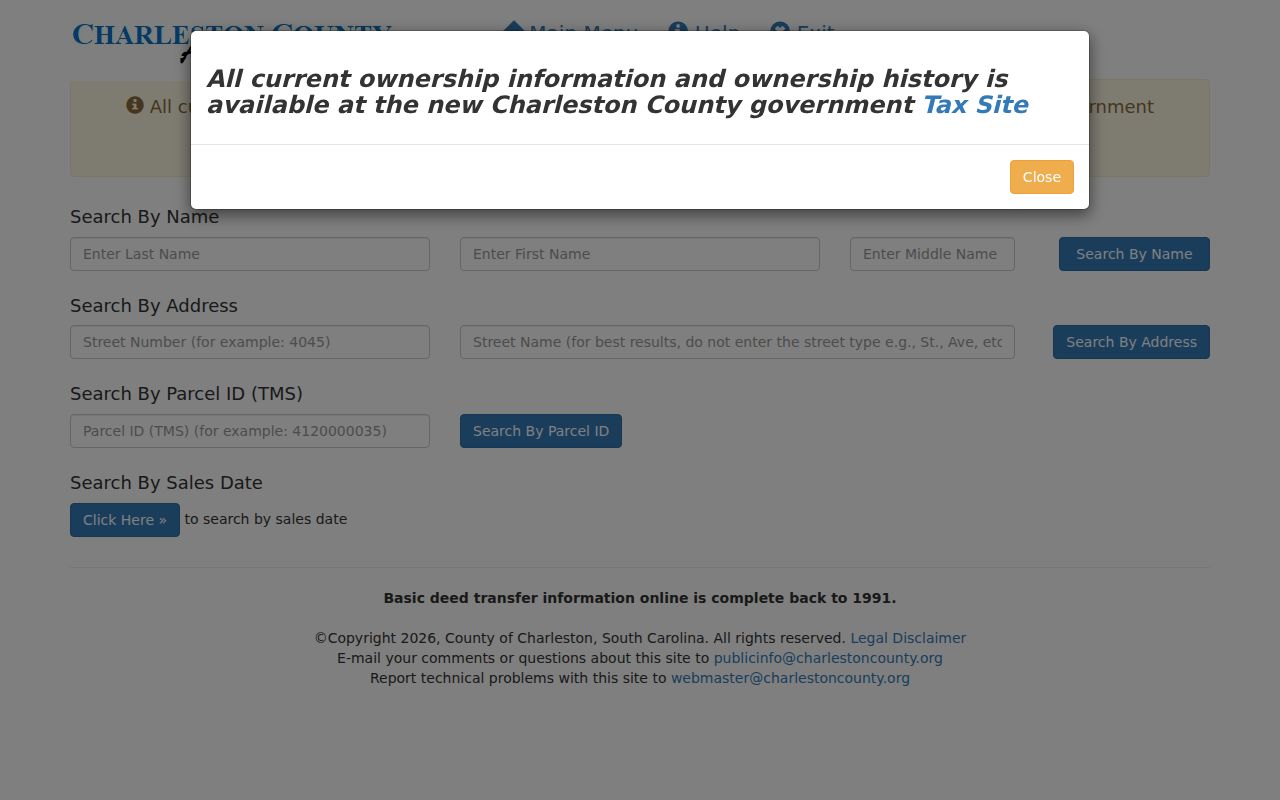
Its separate search paths help keep an address search, an owner search, and a parcel lookup from being mistaken for the same kind of result.
Mount Pleasant Deed Index Trails
After a property card produces a legal description or deed reference, the Charleston County Register of Deeds is the next custodian. Its documented online deed and mortgage index and tracer data begin in 1978, while recorded images begin in 1997. A deed connects grantor and grantee names to a recorded instrument, date, book, page, and legal description. It does not prove that either party occupied the property on every date.
The document search includes deed, mortgage, party-role, date, book-page, tracer, and image paths. A tracer is a later record that refers back to an earlier one, such as a satisfaction identifying an original lien. For older Mount Pleasant research, the ROD reports physical document access from 1719 to 1960 and film or microfiche from 1960 to 2005. The counter, historical books, and library material are essential when the web index stops.
Note: The current-recording Day Book is not a substitute for historical research because the County announced that prior recordings would not be accessible there after November 3, 2025.
Current Mount Pleasant Directory Sources
Current Mount Pleasant directory evidence is fragmented by design. The property card identifies owners, the ROD index identifies recorded parties, a court index identifies parties to public cases, and the voter system serves the voter’s own registration functions. The Town staff directory lists public employees, while the HOA resource describes community support rather than association membership. Select the source for the narrow fact it can support.
| Mount Pleasant source | Recorded connection | Custodian | Access path |
|---|---|---|---|
| Property Record Cards | Tax-date owner, parcel, mailing and situs fields | Charleston County | Owner, address, TMS, or sales-date portal |
| ROD Document Search | Recorded grantor, grantee, instrument, date | Register of Deeds | Online index, counter, historical holdings |
| MySCVotes and SEC process | A voter’s own status or tailored official request | State Election Commission | Self-service or written agency process |
| Town staff directory | Public Town office and employee information | Town of Mount Pleasant | Town directory |
| CCPL historical resources | Dated directory, phone, map, and newspaper clues | Charleston County Public Library | Library card, room, or appointment route |
When the goal is to test one person against several official records, the Mount Pleasant resident lookup process keeps property, court, probate, and historic evidence in their proper lanes. A record’s absence can matter too: it may show only that the person is not indexed by that particular system.
Mount Pleasant Court and Probate Paths
Case research splits by court. The Town Municipal Court handles municipal-code matters and misdemeanor state violations, but no universal public web name search was verified. Charleston County’s Public Index is the general county trial-court starting point. Open case details when public documents are available rather than treating the result list as the whole file. Probate separately handles estates, wills, guardianships, conservatorships, commitments, and marriage licenses.
A case index shows a filing or docket event, not proof of an allegation or a current address. Sealed, expunged, juvenile, adoption, and sensitive family material are not general public search resources. For a historic estate question, CCPL’s South Carolina Room also holds transcriptions and early probate-related material. The record keeper, court division, case number, party role, and date should all be checked before drawing a conclusion.
Mount Pleasant Voter Record Limits
MySCVotes provides voter self-service functions such as registration status, ballot, polling place, and voting history. The reviewed official sources did not verify a public Mount Pleasant by-street roster. The County elections office is the local process contact, while a narrower records request belongs with the State Election Commission’s written procedure. The SEC asks requesters to define the subject, date span, and custodian rather than make an open-ended demand.
South Carolina’s inactive-voter process gives an important caution. A registration record can remain in the system after a voter asks to become inactive, while becoming unavailable for online lookup. That means a missing online result does not prove someone never lived in Mount Pleasant. It is safer to pair a voter-related response with a dated property, deed, or directory record than to use an election record as a household roster.
Mount Pleasant FOIA Fallbacks
Not every useful record is searchable online. South Carolina Freedom of Information Act, S.C. Code Ann. §§ 30-4-10 through 30-4-165, gives a route to request inspection or copies of non-exempt public records. Section 30-4-30 governs response, determination, and production timing, while § 30-4-40 supplies exemptions. Ask the Town or County custodian for records by type, date range, and address or matter when relevant, rather than sending unnecessary personal data in an email.
The Town’s Documents and Information Request path directs requesters to its policy and cost material before the form. Town-held permits, maps, minutes, code material, and correspondence may be reached there when non-exempt. The ROD counter, Clerk counter, Probate, South Carolina Room, and archives are separate fallback channels with their own rules. Ask for electronic delivery and a cost estimate when the scope may require staff search or redaction.
Note: State and local offices can redact protected information, so a requested record can be available in part without every identifier being released.
Mount Pleasant Vital Record Routes
Vital records are not a general Mount Pleasant residents directory, but they can support a narrowly defined family-history or estate question. The South Carolina Department of Public Health Vital Records holds statewide birth, death, marriage, and divorce material under its specific eligibility and confidentiality rules. South Carolina birth certificates reach back to 1915, and a birth record becomes public after 100 years. Certified copies before that public period are limited to the entitled person, named parent, legal guardian, representative, or the documented deceased-person exception described by DPH.
Custody changes by record and date. State central filing for marriages began July 1, 1950, so an earlier marriage is requested from the Probate Judge in the licensing county. DPH holds divorce reports from July 1, 1962, while the Clerk of Court holds the actual decree from the county of final hearing. DPH offers online, phone-vendor, in-person, mail, and drop-off channels according to the record type and applicant status. CCPL historical materials can provide research leads, but they are not substitutes for a certified DPH copy.
Do not send unnecessary Social Security numbers, financial data, birth dates, or medical information in an ordinary email. Use the current official form and give the custodian only the information required to locate the specific record.
Historic Mount Pleasant Directory Records
For older Mount Pleasant residents, the key shelf is CCPL’s South Carolina Room and Charleston Archive. Its city-directory collection includes early book or microfiche abstracts, later microfilm, original books, telephone books, and HeritageQuest runs. Mount Pleasant can appear under Charleston, Greater Charleston, East of the Cooper, or a separate suburb heading depending on the edition. A directory listing is dated evidence of a printed entry, not proof of a full household or a continuing address.
CCPL’s historic-property guide documents a street cross index for 1840 and reverse street coverage from 1890 onward. The years in between may require surname research instead. Telephone numbers begin in 1936, and separate outlying-area sections grow more common in the 1940s and 1950s. The full shelf, entry conventions, and tracing method are set out in the Mount Pleasant city directories collection page.
See the Town’s Research Resources collection before a local-history visit.
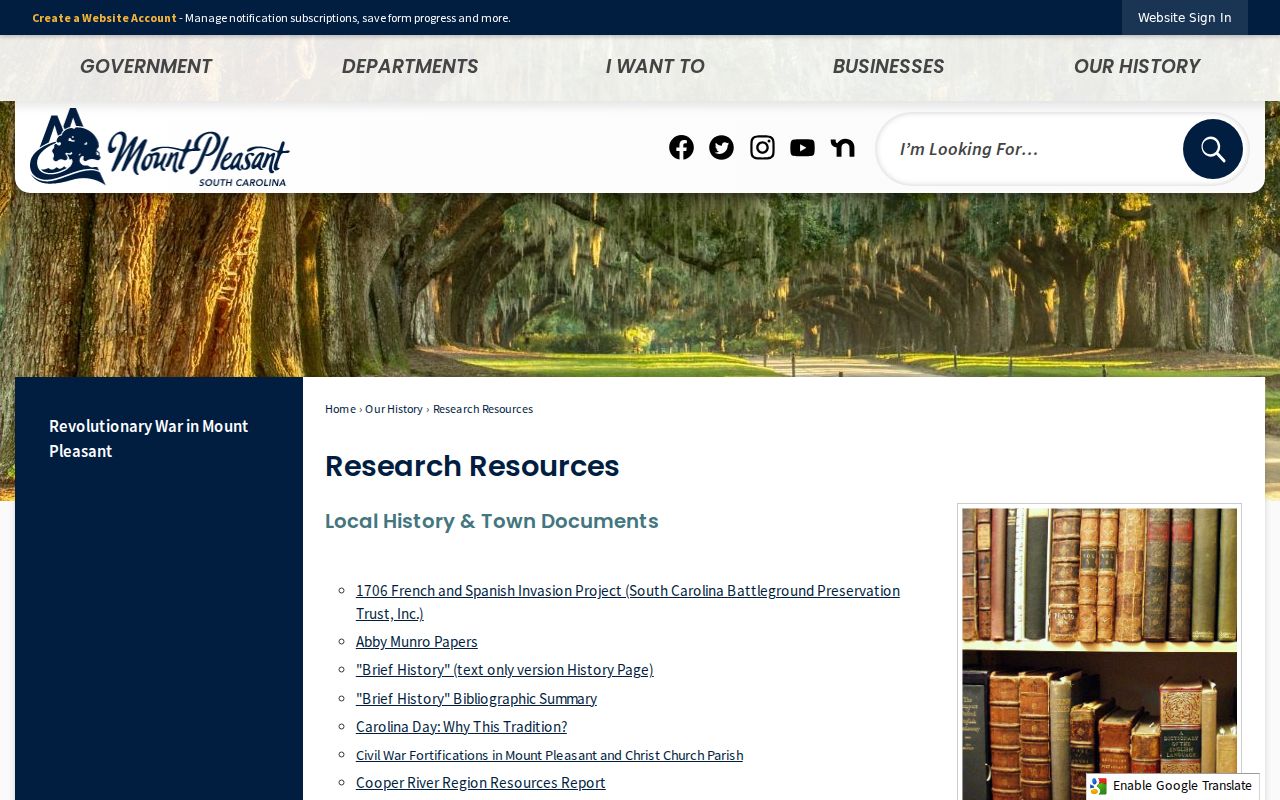
The Town resource list points researchers toward incorporation acts, Council minutes, historic material, and the local History Room rather than claiming a single online resident roll.
Mount Pleasant Records Across Time
Mount Pleasant’s record trail changes with the system and the date. The ROD reports physical recorded-document access from 1719 to 1960, web index data from 1978, and images from 1997. County property transfer information is reported complete online back to 1991. Town OPAL replaced prior permit systems in July 2024. Those cutovers explain why a search can succeed at a counter, in a scanned record book, or in a library collection after it fails in a modern portal.
Historic geography adds another twist. Mount Pleasant was incorporated in 1837, became the Berkeley County seat in 1883 after the county division, and returned to Charleston County in 1895. Old references may use Christ Church Parish, Greenwich, Hibben Ferry, Hilliardsville, Lucasville, or Scanlonville. Match the old place name and legal description to a map, plat, or County record rather than assuming a modern town label existed at the time.
Mount Pleasant Recording Alert Checks
Charleston County announced a property-recording alert system in 2025 to notify residents about activity associated with property records and other official documents filed in their name. The alert is a way to notice activity. It is not a finding that a document is false, and it does not replace reading the actual recorded instrument. For a Mount Pleasant owner researching a deed trail, it can be a sensible current-record complement to the historical work.
When an alert or mailed solicitation raises a concern, check the recorded document through the Register of Deeds and contact the ROD for the record facts. Keep the document number, recording date, and the result of the custodian check. A real document may still need a separate legal or consumer-protection response, but the first step is to verify what was recorded rather than reacting to a headline or a sales pitch.
Mount Pleasant Official Record Checks
Official sources and commercial people-search products serve very different purposes. A County record identifies the custodian, date, and underlying document path. Commercial results can be stale, merged across people with the same name, or missing the record context needed to test a result. A paid result should never replace a dated property card, deed, court file, library volume, or direct custodian response.
| Research route | Strongest use | Limit to remember |
|---|---|---|
| Official property or ROD record | Recorded parcel or document facts | Does not list every resident |
| Library directory edition | Dated household or business listing | Coverage and inclusion vary by year |
| Court or probate index | Public case identity and event trail | Some files and identifiers are restricted |
| Commercial compilation | Possible lead for later verification | Can be outdated, conflated, or incomplete |
Note: Preserve the source, date, and record number for any fact that matters to a family-history, estate, or civic question.